When it comes to securing your home or business, one of the most important decisions you will make is the type of lock to install on your doors. For decades, traditional mechanical locks such as deadbolts and knob locks were the standard choice. The debate of electronic locks vs traditional locks is a hot topic among homeowners and security experts. While both types of locks have strengths and weaknesses, the right choice depends on your lifestyle, security needs, and budget.
However, advancements in technology have introduced electronic locks, which promise added convenience, modern features, and enhanced security. In this guide, we will compare electronic locks and traditional locks in detail, explore their pros and cons, and help you make an informed decision about the best option for your property.
Understanding Traditional Locks
Traditional locks are mechanical devices designed to secure doors by physically preventing entry unless the correct key is used. The most common types you’ll encounter are:
- Deadbolts: The gold standard for exterior doors. They operate with a thumbturn on the inside and a key on the outside. A solid metal bolt extends into the door frame, making it extremely resistant to forced entry.
- Knob Locks: The lock is built into the doorknob itself. These are generally weak and should never be used as the primary lock on an exterior door, as the knob can easily be broken or forced.
- Lever Handle Locks: Common in commercial buildings and homes designed for accessibility. They are easier to operate than knobs, but can be susceptible to forced entry if not properly designed.
- Mortise Locks: A heavy-duty lock where all the mechanisms are contained within a pocket (mortise) cut into the door. Often found in older homes and commercial buildings, they are very secure but complex to install.
Traditional locks rely on a physical key to grant access. Their security depends largely on the complexity of the key design and the strength of the lock’s construction.
The principle is simple: no key, no entry (unless you break it open).
Understanding Electronic Locks
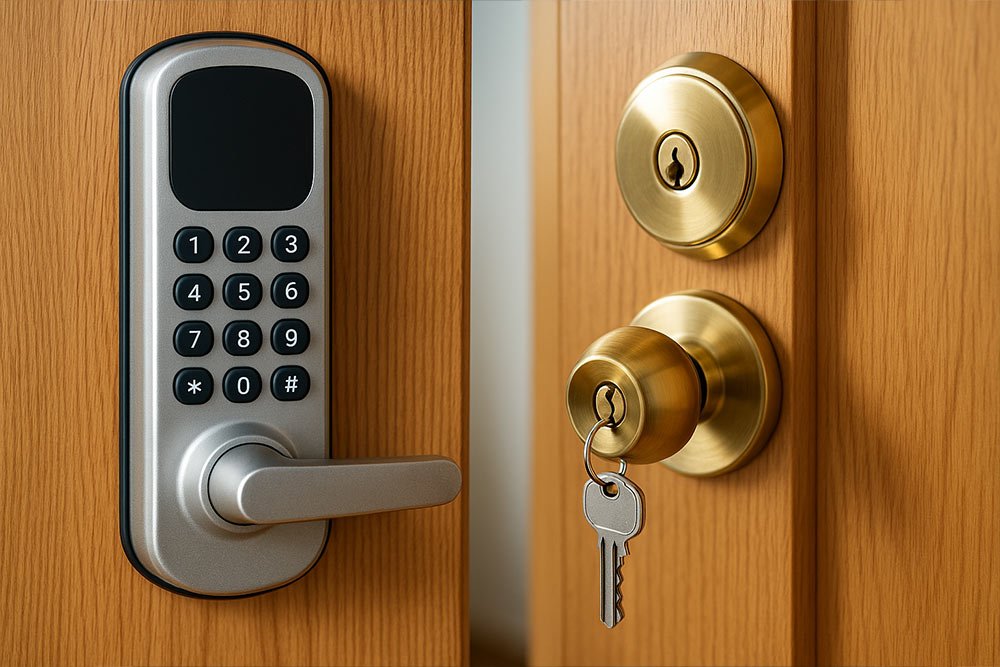
Electronic locks, sometimes referred to as smart locks, operate using digital mechanisms rather than solely mechanical ones. These locks may use a keypad, smartphone app, key card, fingerprint scanner, or even voice control for access.
Common types of electronic locks include:
- Keypad Locks– Require a PIN code to unlock the door.
- Smartphone/Smart Home Integrated Locks– Controlled via mobile apps or smart home systems like Alexa or Google Home.
- Biometric Locks – Use fingerprints or facial recognition for access.
- Keycard Locks– Common in hotels and offices, requiring a swipe card or fob.
Electronic locks offer convenience and enhanced security features, often equipped with remote monitoring capabilities.
Security Comparison: Electronic Locks vs Traditional Locks
1. Convenience and Access Control
This is where electronic locks truly shine, and it is the primary reason for their surging popularity.
Electronic Locks: The Champions of Convenience
- No More Keys: The most obvious benefit. You can leave the house for a run without awkwardly stuffing a key into your pocket. You’ll never experience the sinking feeling of being locked out because you lost your keys or left them inside.
- Remote Access : With smart locks, you can lock or unlock your door from anywhere in the world. Forgot to lock the door after leaving for vacation? A few taps on your phone and it’s secured. Need to let in a dog walker, house cleaner, or a guest? You can grant them a unique, temporary access code that works only for a specified time window. No more hiding keys under doormats.
- Multiple Access Methods: A single electronic lock can be opened via PIN, fingerprint, smartphone, and a physical key. This flexibility is unmatched.
- Access Logs: Most smart locks keep a digital log of every entry and exit. You can see exactly who came in, what time they used their code, and when they left. This is invaluable for monitoring children, service people, or for security audits.
Traditional Locks: The Simple, Tried-and-True Method
- Simplicity: There’s a straightforward elegance to a key. No batteries to worry about, no codes to remember, no apps to configure. It just works.
- Universal Understanding: Everyone knows how to use a key. You don’t need to give guests a tutorial on how to enter your home.
- No Downtime: They are immune to power outages or Wi-Fi disruptions.
Winner in Convenience: Electronic Locks. The flexibility, remote management, and keyless entry are transformative features that traditional locks simply cannot match.
2. Security and Vulnerability
This is the most complex and hotly debated aspect of the electronic locks vs traditional locks discussion. It’s not about which is “more secure” in absolute terms, but how they are secure and what they are vulnerable to.
Electronic Locks: Digital Fortresses with New Frontiers
- Elimination of Key Duplication: You control who has access digitally. There’s no risk of a guest making an unauthorized copy of your key.
- Advanced Encryption: High-quality smart locks use military-grade encryption (like AES-128) for communication between the lock, hub, and your phone, making digital hacking very difficult for the average criminal.
- Tamper Alerts: Many smart locks will send an immediate alert to your phone if someone is trying to tamper with them or after multiple incorrect code entries.
- Vulnerabilities: However, they introduce new attack vectors:
- Low-Tech Hacking: Some cheap electronic keypad locks are vulnerable to “smudge attacks,” where a thief can see the code based on the wear on the buttons or fingerprints.
- High-Tech Hacking: While rare, a sophisticated hacker could potentially exploit vulnerabilities in the software or the home’s Wi-Fi network. Brands with a strong security focus constantly patch these vulnerabilities.
- Power Dependency: If the batteries die and you have no backup power method (like a key or external battery port), you are locked out. Most quality locks give you ample low-battery warnings.
Traditional Locks: Physical Barriers with Age-Old Weaknesses
- Physical Strength: A high-quality Grade 1 or Grade 2 deadbolt, installed correctly in a reinforced door frame, is incredibly resistant to brute force attacks like kicking, battering, or crowbarring.
- Proven Technology: The mechanics are well-understood and not subject to software glitches or remote hacking.
- Vulnerabilities: Their weaknesses are also well-known:
- Lock Bumping and Picking: A skilled individual with basic tools can pick or bump many traditional locks in seconds. YouTube tutorials have made this knowledge widespread.
- Key Control: Anyone with physical access to your key can make a copy. You have no way of knowing how many copies of your key are floating around.
- Lock Snapping: A specific and common attack on certain types of euro cylinder locks (common in the UK and Europe) where the lock is physically snapped in two to gain entry.
Winner in Security: It’s a Tie. It’s a battle of different paradigms. A high-end traditional deadbolt is excellent against physical force but weak against skilled picking. A high-end smart lock is excellent against picking and key duplication but introduces potential digital vulnerabilities. The best security often comes from layering both—a strong smart lock with a traditional key backup on a reinforced door.
3. Cost and Installation
Electronic Locks: A Higher Initial Investment
- Purchase Price: A good quality electronic lock starts at around $150 and can easily go up to $300-$500 for premium models with multiple features. A basic traditional deadbolt can be purchased for as little as $20-$50.
- Installation: Many electronic locks are designed for DIY installation and are “aftermarket” devices that fit over the existing hole in your door. However, if your door isn’t compatible or you’re not tech-savvy, professional installation can add $100-$200 to the cost.
- Ongoing Costs: You will need to replace the batteries every 6-12 months.
Traditional Locks: Affordable and Straightforward
- Purchase Price: Very affordable. Even a high-security, pick-resistant traditional deadbolt from a brand like Medeco or Mul-T-Lock will typically cost less than a high-end smart lock.
- Installation: Simple to install for any handyperson or locksmith. Standardized sizes make replacement easy.
- Ongoing Costs: Virtually zero. No batteries, no subscriptions.
Winner in Cost: Traditional Locks. They are the undisputed champion of affordability, both upfront and over the long term.
4. Durability and Maintenance
Electronic Locks: Complex but Robust
- Durability: Well-made electronic locks are designed for outdoor use and can withstand weather extremes. However, their internal circuit boards and motors are more complex points of failure than simple mechanical parts.
- Maintenance: Requires very little physical maintenance but is dependent on battery power. Failure to change batteries is the number one cause of issues.
Traditional Locks: Simple and Long-Lasting
- Durability: A well-built brass or steel deadbolt can last for decades, even generations, with minimal issues. They are workhorses.
- Maintenance: Occasionally, they may need lubrication with graphite powder (not WD-40, which can gum up the mechanism) or internal adjustment if they become stiff.
Winner in Durability: Traditional Locks. Their sheer simplicity and lack of dependency on electronics give them an edge in long-term, trouble-free reliability
Use Cases: When to Choose Electronic Locks vs Traditional Locks
Best Scenarios for Traditional Locks
- Budget-conscious homeowners who want reliable security at a low cost.
- Older homeswhere modern wiring and connectivity may not be feasible.
- Low-tech environments where simplicity and mechanical reliability are priorities.
Best Scenarios for Electronic Locks
- Tech-savvy homeowners who want modern security integrated with smart home systems.
- Rental property owners who need to frequently change access codes for guests or tenants.
- Busy families who prefer convenience and keyless entry.
- Businesses and offices where controlled, trackable access is important.
Pros and Cons at a Glance
Traditional Locks
Pros:
- Cost-effective
- Simple to use
- Long-lasting and durable
- Resistant to electronic hacking
Cons:
- Keys can be lost or copied
- Inconvenient for multiple users
- Vulnerable to lock picking and bumping
Electronic Locks
Pros:
- Keyless entry for added convenience
- Remote monitoring and control
- Customizable access codes for different users
- Can integrate with smart home systems
Cons:
- Higher upfront cost
- Requires batteries or electricity
- Vulnerable to hacking or technical glitches
- More complex installation and maintenance
Future Trends in Lock Technology
The security industry is continuously evolving. Electronic locks are expected to become more common as smart homes and IoT (Internet of Things) technology advance. Biometric access, voice recognition, and AI-powered security systems may soon dominate the market. However, traditional locks are unlikely to disappear, as their simplicity and proven reliability continue to provide peace of mind.
Making the Right Choice: Electronic Locks vs Traditional Locks
When choosing between electronic locks vs traditional locks, consider these key factors:
- Budget– Traditional locks are cheaper, while electronic locks come at a higher cost with advanced features.
- Lifestyle– If you value convenience and technology, electronic locks may be worth the investment.
- Security Needs– High-quality deadbolts offer strong physical protection, while electronic locks add control and monitoring features.
- Property Type– Residential, rental, or commercial settings may influence the ideal choice.
- Backup Options– Choose a system with both electronic and mechanical access to avoid lockouts.
So, in the battle of electronic locks vs traditional locks, who wins? The answer is: it depends on your priorities.
You Should Choose an Electronic Lock If:
- Convenience is your top priority. You hate carrying keys and love the idea of remote access.
- You need to grant access to others frequently. You have kids, dog walkers, cleaners, or frequent guests.
- You want advanced features. Access logs, integration with smart home systems (e.g., “Alexa, lock the front door”), and tamper alerts are important to you.
- You are a renter and want a removable, upgradable security solution.
You Should Choose a Traditional Lock If:
- Your budget is the primary concern. You need the most security for the least amount of money.
- You value simplicity and reliability above all. You don’t want to worry about batteries, software updates, or Wi-Fi connections.
- You live in an area with extreme weather that could affect electronics.
- You are a “set it and forget it” person who doesn’t need advanced access features.
Conclusion
The debate between electronic locks vs traditional locks ultimately comes down to personal preference, budget, and security needs. Traditional locks remain a reliable and affordable option for many homeowners, while electronic locks offer the convenience and advanced features that modern lifestyles demand.
Securing your home is not a one-size-fits-all decision. By weighing the pros and cons of electronic and traditional locks, you can select a solution that provides the right balance of security, convenience, and peace of mind for your home using lockout emergency locksmith services.